Sunday, September 29, 2013

Location, Location, Location

Location is Everything


Every good real estate agent will tell you how important location is and every good gardener will tell you the same. The location of your plant is as important as the location of your house and micro climates are found everywhere. 
 

Micro Climates


For today's lesson, I present to you two plants that are in my garden. They are a common house plant in many parts of the country so they are a good choice to study. The one in the picture on the right is healthy and happy. You can see another in the background of that picture and its close up is on the left. They are both the same kind of plant. They were both cut down in the spring to bare stalks so that that both would grow at the same rate. How come the second plant is not doing well? 


They are less than three feet apart and one is just a little farther north. You can almost say they are planted in the same location. They got the same amount of water and food, so what was different? It took me a couple days to observe that though they were so close one got more sun.  The other was shaded only 20 minutes more by the large tree next door and that made all the difference.

So, What Does That Mean to You, an Indoor Gardener? 


Just think, if just 3 feet outdoors can create a completely different micro climate then how little space is need to change it indoors. The 36 inch window will have a shadier side; the tub of artificial light is brighter in the center than the ends.  Then there will be the outside factors.  The tree outside the window, the direction of the sun, the neighbor's fence, a lot can effect you best laid plans. 

So take a second look at the location you have chosen.  There can be many reasons for a plant not to do well.  Start with the things you can control.  Is it getting enough water?  Is there any sign of infestation by bugs?  Has it outgrown its location?  Then take a good look at the actual location.  What quality of light is being offered?  How is the heat?  Is it too close or too far from the source?  Could a breeze be causing damage?  Could it be the lack of breeze?   

It doesn't take a college degree to grow houseplants.  It only takes a little observation.  So keep  your eyes open and keep trying. Write me if you have any problems.

Reach me through this website or email me at houseplantsos@gmail.com

Sincerely,
k.k.jones


Wednesday, August 21, 2013

A Rabbit's Foot for Luck


Well it has been a while since I wrote and I apologize.  Summer is here and I have been out in the garden.  By now most of you have joined me and unless you are one of the many who only garden indoors, you probably did not even miss me.


I have a lot of things I have been gathering and lots pictures to help show you what I want you to know. I am starting today with a favorite of mine.  That is the Rabbit's Foot Fern (Davallia).


The Davallia fern is definitely not collected for its foliage but its growing habits makes it a "must have" for any person who wants something unusual.  The thing that makes it unique is that it would prefer not to have a pot and will continue to grow wrapping around itself or any other structure that will give it support.  The one above is in a wire basket with a little moss and bark chips to help keep it from drying out. Notice how  each rhizome looks like a little furry foot.  This is where this family gets it's name as footed ferns. 


The "fur" is small root hairs that help to hold water and allows this fern to tolerate lower humidity that most other ferns.  The one pictured is a Davallia fejeenisis (Rabbit's Foot Fern) which is the one that is the most common  in the US and can be bought in a small size at most garden centers. Other rather easy Davallia's are the canariensis, the pyxidata and the solida. Some of their common names are Hare's Foot, and Squirrel's Foot Fern. There are more Davallias that are more difficult and some that are even deciduous.  This means that they will lose their leaves in the winter and look like a large ball of roots. I would try to stay away from them if you are a beginner.

Water regularly in the summer when it is growing and then slow down in the winter when it goes into a dormant phase.  If your fern is in a basket with little or no medium, regularly may mean that you will need to mist a couple of times a week.  

When it is time to repot there are a few noteworthy rules to follow.  First and for-most: do not bury any root that has already exposed itself to the air. This is now an air root and will rot if buried.  Second: the potting medium should be course like you would use for an epiphyte orchid.  This allows the furry rhizomes to develop better.  Fertilizer is light and you can use a slow release or a half strength solution of a liquid formula.  

Pests to watch for are aphids, mealy bugs, scale and thrip. A good hosing or indoors a trip to the showers should take care of most infestations.

If you would like to know more about this fascinating plant check out  the Fern Society of South Australia, Davallia Study Group . Though I have owned Davallias over the years there is always something new to learn.  I thought it amazing that we usually buy our new plant in a plastic pot and this species does not like them.  Keep to the more porous pots.  If you cannot do a hanging basket because of the mess that is sometimes associated with it then use a clay pot.  

Well, that is all for today.  I hope this was worth the wait.  I promise that I will go back to writing more often.

Please direct any questions or comments to me in the comment area of this post or email me at houseplantsos@gmail.com.

Sincerely,
k.k.jones 


Wednesday, July 3, 2013

Jasmine for Jennifer

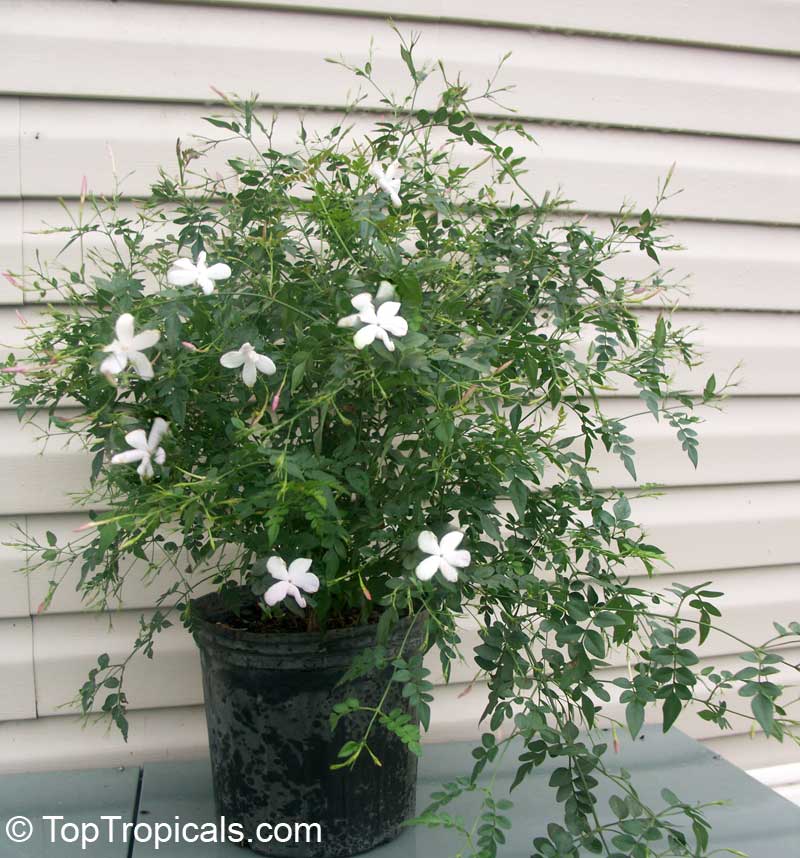
 One of my readers wrote that she had purchased a jasmine plant but could not get it to bloom.  So, here is probably the reason why.

How to Get a Jasmine to Bloom

Jasmine, though thought of as a tropical, like cooler temperatures.  To get it to bloom it will need night temperatures of around 40 degrees and day temperatures of 65.  This makes it a Spring bloomer naturally which also explains why my Jasmine is not in bloom and I had to borrow pictures from other sources.  I guess that means that your best bet to get your Jasmine to bloom now is to place it near the air conditioner.  

Jasmine also like sunny windows and are prime candidates for taking outside for the summer. The best time to prune is right after it has bloomed, as new flowers are formed on new growth.  Fall pruning may also cause you to miss blooms when it will re-bloom with the cooler temperatures.  

The Basic Care

I have already mentioned that the Jasmine likes a sunny location.  It will also do well under artificial light if you balance it with complete darkness.  Like most Spring and Fall flowering plants the amount of darkness they get helps to set the buds.

Watering is very important to this plant.  It should never be allowed to dry out.  Though you should be careful not to over water, this plant will do okay with a saucer to sit in.  

Fertilize lightly.  You should fertilize every other week with a half solution of low nitrogen fertilizer.  The nitrogen is noted by the first number in the fertilizer formula so a 10-20-10 solution would be best.  A 10-10-10 solution will do if you cannot find one, as this is a general formula for all plants. 

Hope this helps.  I will write again on the Jasmine and tell you more about it as there are 200 species. In fact when searching for a picture to put in this posting, I came across the picture of my "minature Gardenia" that I talked about in the posting "Catching Up On Odds and Ends". Looks like I will have to do a little more digging on that one.  If anyone knows which this is please write and I will share with others.

If you have any questions or pictures you would like to add to this blog please add to the comments or email me at houseplantsos@gmail.com.

Sincerely,
k.k.jones

Sunday, June 23, 2013

Isn't She A Beauty

Thank you Jennifer for sending me this beautiful picture of a Mandevilla.  This is a beautiful example of a small plant that can become very large as it vines its way up.  Jennifer, can you tell us how lod your plant is and do you keep it prunned to be sure that it does not get to big?

For those of you who have never seen a Mandevilla, this is a pink one and the easiest to find.  It also comes in white, red and yellow.  I will dedicate a posting on this plant soon.

Jennifer also sent me a second plant that was not in bloom but it is one of my favorites too.  It is a jasmine plant.  Unfortunately, my download failed.  Maybe we can get Jennifer to resend this picture and hopefully it will be in bloom. 

 Thanks again.

Coleus A Jewely In The Garden Or On The Window Ledge


The Coleus is a common name for the genus Solenostemon. Don't bother using its genus name because not many people will know what you are talking about.  I actually had to look it up.  It has a blossom that grows ain a spike form and is very small.  I personally think that it takes so much energy for a plant to create a bloom that unless it is outstanding it should be cut off.  This will also allow the plant to branch and encourages more growth.


Many of the Coleus we see today are hibrids with a large varity of pattern in colors of red, green and gold.  Take a look at the two Coleus below.  The one on the left is a fairly old leaf pattern and the one next to it is a newer one that appears to have been created from it.

Rosy Dawn Gardens calls this coleus
"Under The Sea Electric Coral"

Care of Coleus

New this year, this style of leaf
is a Hort'couture
Temperature:  All Coleus are tender.  This means that though you will see them in many gardens they will not survive a freezing temperature.  Because of this they make great houseplants.  They like temperatures above 60 degrees and will tolerate a low light situation.  

Light: In their natural habitat, Colus will be found in deep to dappled shade.  This makes them great for a window that gets little actual sun.  A little extra light will keep the foliage color more intense.  

Water: This plant likes to keep its roots moist but be sure you allow it to drain so that it does not drown.  

Pests: Coleus can become infested with the list of common bugs I talked about before.  If you have forgotten you can see them on my Pinterest Board. The posting on 5/9/2013 will help you with instructions on how to debug. One bug that I did not mentioned was the soil gnat or fungus gnat.  This is a tiny black fly that will hover around the soil in the pot.  This insect is usually an indication of too much water. 

Propagation

Propagation is so simple. This is a wonderful first-timers project.    All you need is a mother plant, soil, scissors, water and some rooting hormone.  You may even try just take a cutting and place it in water. A cutting is taken from the mother plant with the top and at least two or three inches of stem.  Remove the lower leaves carefully so as not to tear the stem.  Dip the stem in water deeper than the nubs left over from the removed leaves.  Now dip into the rooting hormone to the same depth.  Place in soil that has been watered and you are done.  Be sure that you do not let the soil dry out and before you know it you will have a new plant.

This is the first time that I mentioned propagation of the plant I am talking about and I did so because it is one that you can share with all your friends and family.  Now is a good time to pick one up because gardeners use Coleus as annuals and are easily obtained from any garden center.  So go ahead and choose.  You can let it grow in the garden all summer and then propagate houseplants for your and your friends' homes.

I have added these pictures and more to the Pinterest Board Beautiful Foliage. If you have any questions or pictures of your own Coleus please email them to me at houseplantsos@gmail.com.


Saturday, June 15, 2013

Catching Up On Odds & Ends

Strawberry Begonia

I added this picture and more to my Pinterest Board "Beautiful Foliage"
For the record, a strawberry begonia is neither a strawberry nor a begonia.  I do not know why it is called this except that it has a begonia looking leaf and it has marvelous runners like a strawberry that can grow up to two feet long.  

This plant is a Saxifraga Stolonifera which is an all together different family.  The runners make it a good grown cover in the frost zones between 7 and 10, but is favored as a houseplant because of it's beautifully marked foliage and the runners that will trail over the lip of a hanging pot. 

To grow inside, the Saxifraga Stolonifera likes a cool filtered sun.  It will grow in height to about eight inches.  You should feed it a standard fertilizer during the growing season.  Cut back on both fertilizer and water over the winter rest period.

Gardenia radicans?

 I have added some new pictures of this flower to

 my Pinterest Board "The Gardenias Are In Bloom".
Remember me telling you that the Gardenia is a large genus of plants?  Well here is one that I think is a good one to find.  As you see, the blossom is much smaller than the Gardenia jasminoides that I mentioned in a previous post.  This is a miniature Gardenia.  It grows in my neighbors yard and smells divine. Unfortunately, I am having difficulty finding out anything about this variety. It might be part of the radicans family but the ones I find on line do not have as many petals.  I am hoping that there is someone out there who might recognize it and tell us all more about it.  The plant is only about 3 feet tall which would make it a good plant for a conservatory or a large sunny window.  I will keep searching for answers.


I Guess I Know More Than I Thought

In February, I mentioned that sometimes plants do things that we don't think they should do.  My example was a flower stem of a phalaenopsis that I had cut off the plant after it was finished blooming.  I had stuck it in the dirt and to my surprise I watched it create two new buds.  I did not know what to think but hoped that the buds would become the beginning of plants, since I was sure that they could not really be flower buds.

Here is the update on this strange phenomena.  The buds dried out without producing anything.  Two more developed with the same results.  I finally removed the stem from the soil to see what was going on below and there was nothing.  So, my plant was the liar not me.  Do not let this discuorage you from trying something new.  My friend Rhona thinks that you can stick anything in the soil and it will grow.  Many times she is right.

Next time, we will talk about the wonderful world of colorful coleus.  These are great plants that can bring a myriad of color to the house. Until then, write me at houseplantsos@gmail.com or add any comments right here.


Thursday, June 6, 2013

Begonia Part 2 - Tubers and Corms

Regal Begonia

Beauty from a Corm

I love this flower.  It is as beautiful as a rose and much more sturdy. The stem is short which means that it would be hard to place it in a bouquet but a single bloom in a shallow dish can really make a statement.  This is a Begonia Rex or sometimes called a Regal Begonia.  It is grown for it's majestic flower and it starts with a corm.

Corm of a Rex Begonia
For those of you who do not know what a corm is, it is a type of tuber.  The tuber most people are familiar with is a potato. As potatoes come in all different shapes and sizes so do tubers.  Corms are in the specific shape that is referred to as a button. Much like a bulb, it has an up and down side to it and needs to be planted correctly for the best results.  Unlike a bulb new plants will grow from the same corm and it can be easily propagated by cuttings the corm into pieces.  You just need to be sure that there is a good "eye" on each piece.  The corm is planted quite shallow in a wide mouth pot and placed in a well lit location.  You can buy this Begonia already blooming but for a bigger variety you can start with corms from a number of good growers.  I do not want to endorse any in particular so I will suggest that you ask the experts starting with The American Begonia Society .

Tubers That Are Not Corms


Also, included in the tuber family is the Begonia that they call a Rhizomatous Begonia.  This tuber looks more like a lumpy potato  and as you can see it can be quite large.  If you go to my Pinterest board on Begonias I have included a picture of a tuber without dirt and you can see that this style of tuber is more complex but much easier to cut apart for creating new plants. You plant it the same as you would the corm.   I have added a planting diagram at the bottom of the page to help answer any questions you may have.


The Rhizonatous Begonia usually does not have a showy flower and is mainly grown for its interesting leaf.  This is mine.  The leaves are about the size of a man's hand and have a hairy surface that kind of feels like new beard stubble.  The stems are very hairy.  I added a picture of the flower on the last posting so I will not take up space here.  What you do not know is how small the flower is.  Look closely at the upper part of the picture and you will see a small branching to the back of the plant.  This is not another plant behind my Begonia. It is the flower.  I will be adding some more of these beauties to my Pinterest board so you can see how beautiful they are.

Care

Like the rest of this family most tuber Begonias like bright but not direct sunlight.  It will be quite happy in an Eastern window.  If you need to put it in a Southern or Western window you would be wise to keep it back from the actual light by about 2 feet.

Some tuber Begonias will become dormant.  If yours starts to look peeked then this may be the problem.  Stop watering and allow it to rest.  If you loose all your leaves you will need to check the the tuber to be sure there is no rotting.  Replant in new potting medium and wait to see new growth before you begin to water.

Begonias like damp soil but not wet so be careful not to over water as they will rot.  They would prefer to be misted daily or placed on a humidity tray like I have mentioned.  

Well, that is it for today.  I hope you like my posting today.  I got more into the how and would like your opinion on this posting.  Would you like more postings like this, that would cover things like propagation through cuttings and seeds?

Add your comment to this blog or email me at  houseplantsos@gmail.com . Remember  to send me any questions you have or you can contact me through Fiverr to set up a Skype  diagnosis visit.

Til then, all my best.
k.k.jones

One last word, a Strawberry Begonia is not a Begonia.  I think it is called that because of the shape of its leaf.  We can discuss that at another sitting.